The Frame Is the Joke
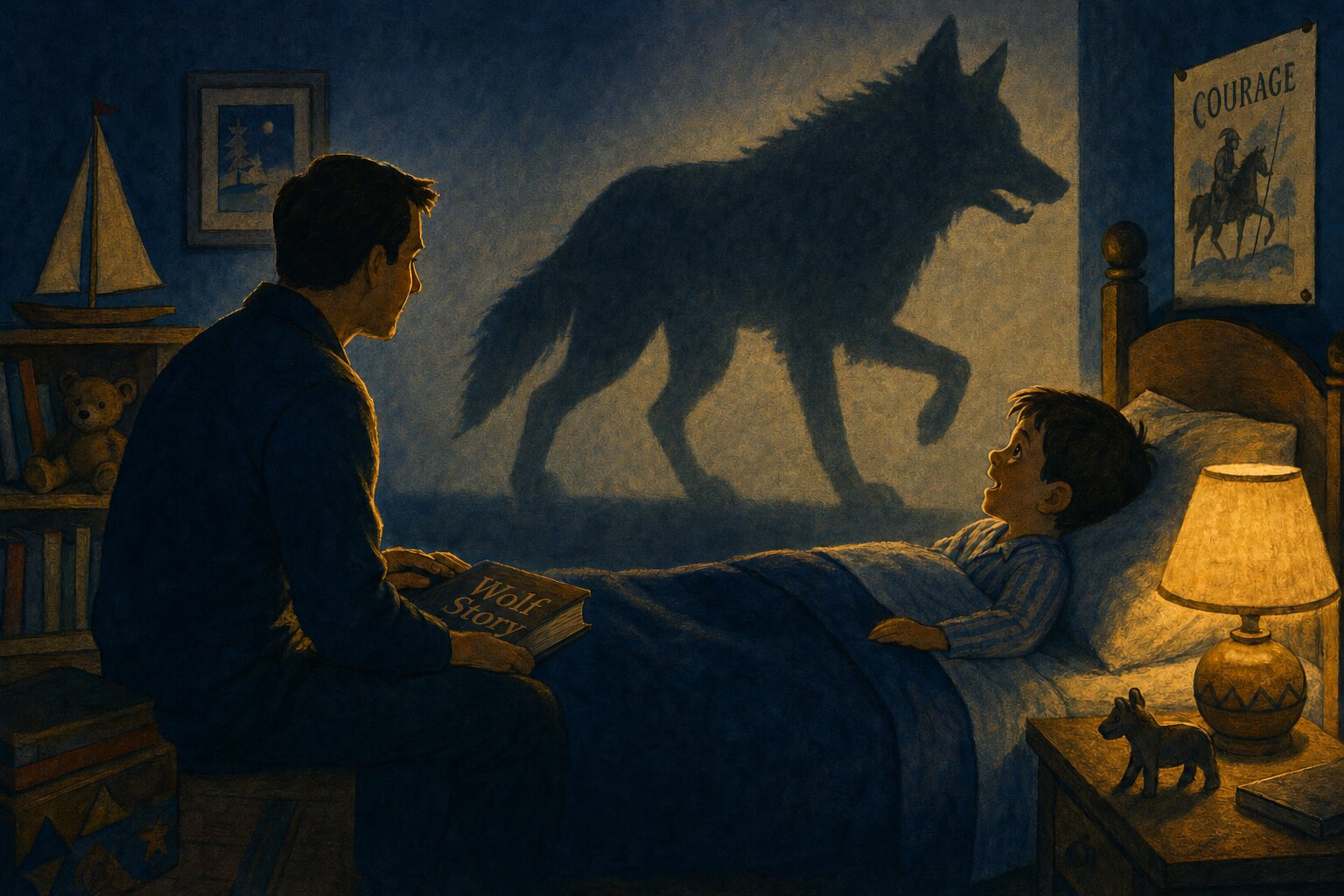
A bedtime story looks like the least promising place to build comedy. The plot is a wolf chasing a hen across a farmyard. The audience is five years old and has opinions about everything.
William McCleery built Wolf Story on that flimsy frame in 1947, and it’s still one of the funniest books in print. The trick is where the comedy lives. The inner story (the wolf’s endless schemes against Rainbow, a hen with feathers all colors of the rainbow) is fuel, and modest fuel at that. The laughs come from the outer story: a father telling the tale, and his son Michael, who treats the telling as a negotiation he intends to win.
Michael demands a wolf with teeth as sharp as butcher knives. The father supplies one and reaches for an ending. Michael refuses it. So the story resumes, in the car, at the beach, with Michael’s best friend tagging along, each installment renegotiated line by line while the father announces at every close that this time, really, it’s over. He surrenders. He stalls. He pretends the new direction was his idea.
The timing works in small rooms too. “Did you brush your teeth?” “When?” said the boy. “Tonight.” “Not tonight, no,” said the boy. “Shall I?”
That’s the machine worth stealing. A story told inside your story comes with a second plot for free: the plot of the telling. The tale only needs enough life to be worth interrupting. The argument around the tale is where the personality lives, and it’s the part a reader can perform out loud — the outer dialogue is a duet, and you get to play both parts.
Find the scene where one of your characters tells another character a story, then move the comedy out of the tale and into the telling. Let the listener derail the story twice. Give the teller one moment of reluctance that is obviously enjoyment. Let the tale go thin while the argument over the tale carries the scene.