If Your Narrator Is Older Than Your Protagonist
Every coming-of-age story turns on a decision the writer makes before the outline: whether the kid runs from adulthood or at it.
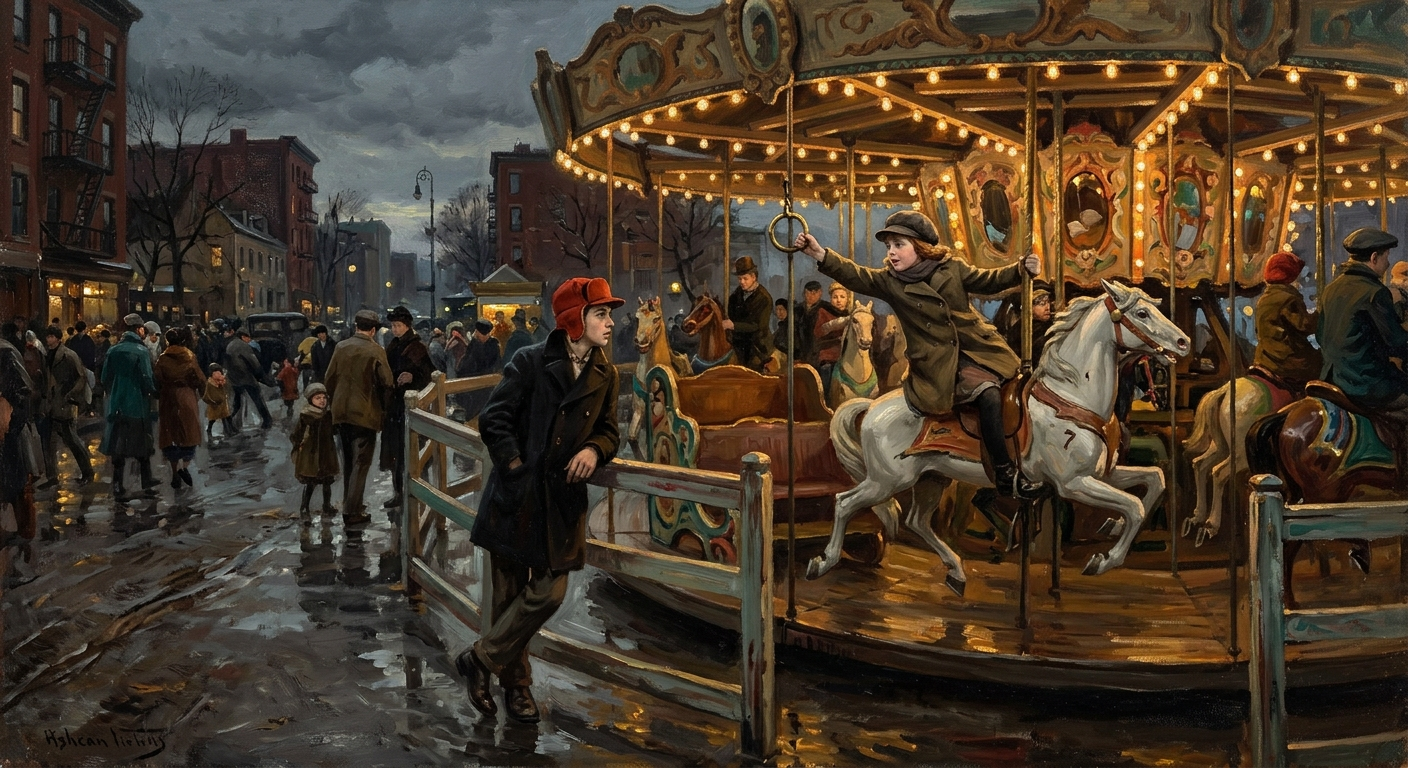
In The Catcher in the Rye, Holden Caulfield runs from it. He tells us his dream himself: “I have to catch everybody if they start to go over the cliff… I’d just be the catcher in the rye and all.” The cliff is the edge of the adult world, and he spends the whole book flunking out of schools and picking fights with phonies to keep the kids on the safe side of it. He loses, because the cliff is coming whether he catches anybody or not. The book ends at a carousel in the rain, his little sister reaching for the gold ring while Holden sits on a bench and lets her reach.
In Great Expectations, Pip runs at it. “Great expectations” land on him from a stranger, and he’s off — out of the forge, out of Joe’s kitchen, into London and a gentleman’s coat. He gets the whole prize, and then Dickens hands him the bill. When Joe comes to visit, Pip admits: “If I could have kept him away by paying money, I certainly would have paid money.” The prize is hollow at the center, and the rest of the novel is the long walk home.
Same theme, opposite engines. One kid holds the line against growing up; the other can’t wait to cross it. Both books are really about where the line costs them.
Here’s the craft part writers skip. Both stories are narrated by the older self looking back. Holden tells his from a rest home a year later, still covering for the kid he was; the book ends on “Don’t ever tell anybody anything. If you do, you start missing everybody.” Pip narrates from middle age and winces on every page. The growing up happened to the kid. The story happens in the gap between him and the voice that survived him, and that gap lets you judge without preaching: the older voice knows, the younger one doesn’t, and the reader feels both.
Try this with your young protagonist: write one sentence, in their voice, about the adult world. Contempt makes them a Holden; hunger makes them a Pip. Then find the scene where that stance costs them something they can’t get back. If there’s no such scene, the arc hasn’t started yet, whatever else has happened. Write the chapter where the stance breaks.